
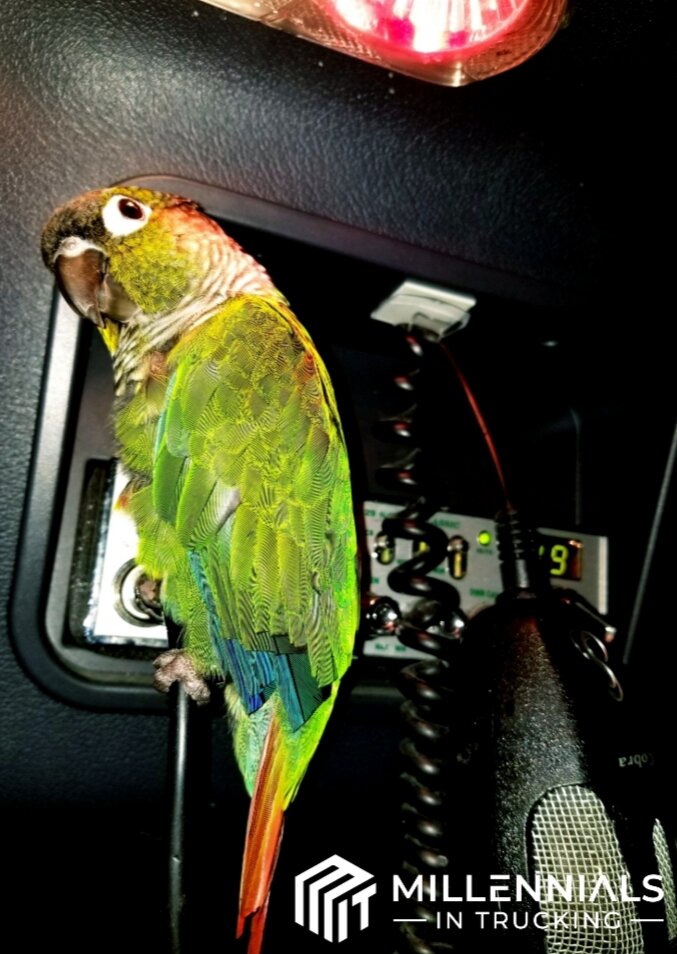
Pet Friendly Roads
“More trucking companies are becoming pet friendly due to driver demand.”

Our truck travels with 6 heartbeats going down the road at any given moment, and only 2 of which are human.
Yes, I’m serious.
That being said, pets have become a large part of our daily lives. The trucking community has undoubtedly taken part in that statement. You can almost guarantee that within earshot of you at any trucking location, there’s a pet on-board. Dogs, cats, birds, ferrets, bunnies, and even some exotics can be seen sitting passenger in a rig or on a pillow on the dash.

Are truck stops pet friendly?
Yes. Most truck stops have designated areas just for our furry friends. Outside of tight, city limit truck stop locations, almost all truck stops have ample fields of grass for you to let your pup outside for necessities and fun! More truck stops now are implementing gated dog parks and dog runs. Some newer locations are including play equipment for the dogs and picnic style seating for their human companions.
What paperwork do I need?
Always carry a copy of your vet records, rabies tags, chip info, and a tag with identification information for your pet. At minimum you should have their latest/up to date vaccination records. Especially if you might be crossing the Canadian or Mexican border, you can be asked for proof of vaccinations.

Are all trucking companies pet friendly?
No! Though the good news is more trucking companies are becoming pet friendly due to driver demand. Some of these companies still come with heavy stipulations. They can include quantity limits, combined weight limits, nonrefundable pet fees, or pet deposits.
i.e. 2 pet maximum with a combined weight of 100lbs with a $250 nonrefundable pet fee per pet.

Are warehouses pet friendly?
It’s safe to say, most customers don’t have any issues with pets. We’ve been surprised with dog treats from security guards, and employees coming out to meet the dog they heard about sitting in the drivers blaring the horn. If the customer doesn't allow pets, your company should know in advance but if not, you’ll surely find out when you arrive. At the very least, a customer will request you keep your pet in your truck at all times while on the yard. This is a given, it’s simple common courtesy as a professional driver and pet owner. Please do your part to follow pet policies at customers.

Dogs Choice Awards 🐕
Dog Parks:
Canterbury Park, Aurora, CO
Cherry Creek State Park, Aurora, CO
Memorial Park, Gibbstown, NJ
Spanish Fork Dog Park, Spanish Fork, UT
Truck and Travel Centers:
Russell's Truck and Travel Stop
Glenrio, NM
Petro Travel Centers
Colby, KS
Bordentown, NJ
Travel Centers of America
Walcott, IA
Hebron, OH
London, OH
Love’s Travel Stop
Conneaut, OH
Hubbard, OH

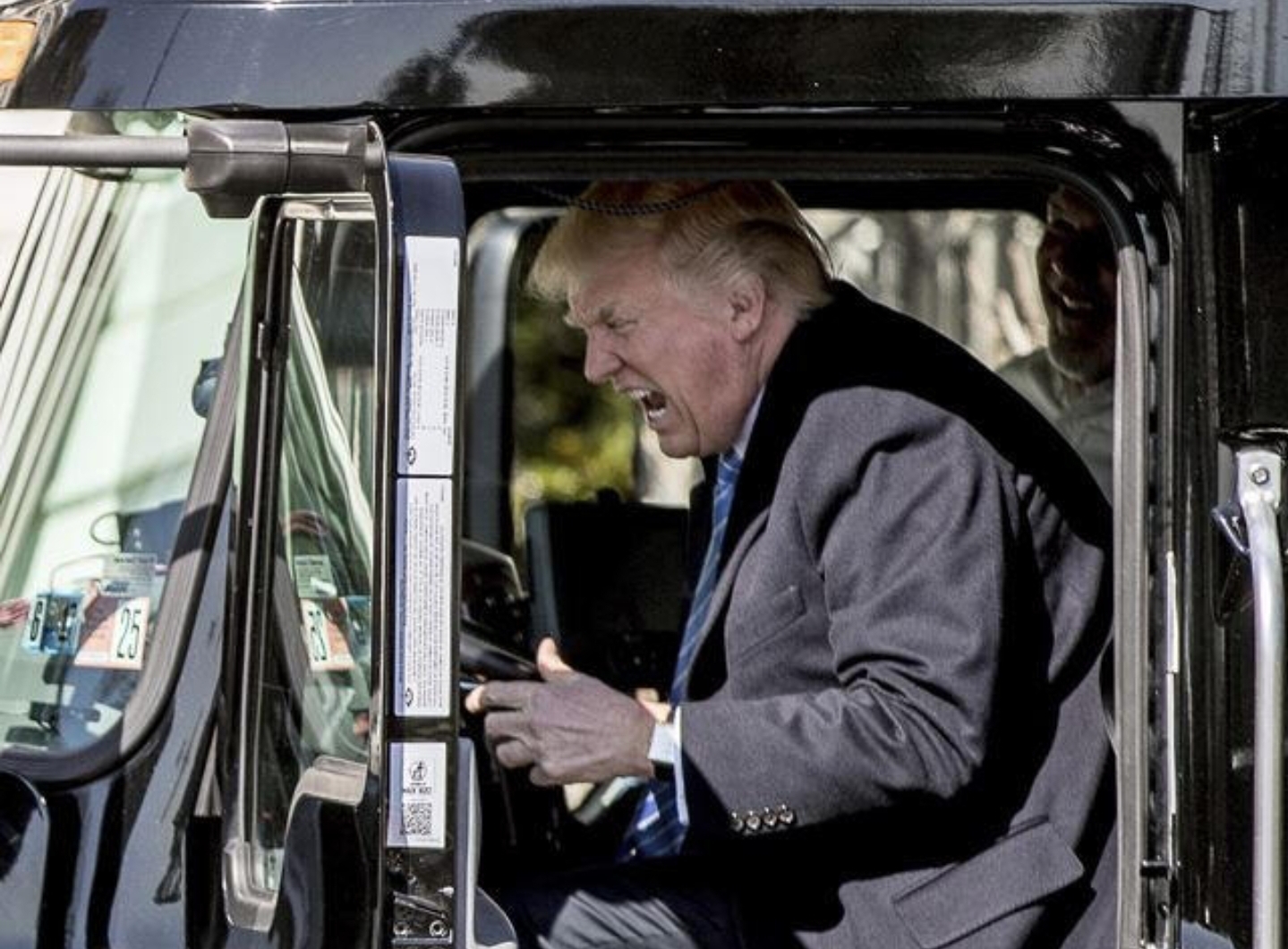
Road Rules - Trucker Edition
Thoughts from within the trucking community.
This segment is from trucker to trucker featuring points we all make to eachother sometimes with the use of sign language through our windows, or verbally over the CB radio.

Here’s a brief highlight of what professional truck drivers will agree on and what the rooks need to know before taking the wheel to the highways.
Pull up when you’re done fueling. This can’t be said enough. There’s nothing worse than waiting behind a truck that isn’t fueling and the driver is M.IA. Don’t make another driver wait for you to run your errands or to take your 30. Pump your diesel, DEF, and reefer, and move along speedily. If there isn’t another truck in the pull up, you should be able to get all 3 services in 15 minutes. We’ve all got somewhere to be, so don’t assume another drivers responsibility to adhere to your schedule if you’re the type to throw a wrench in theirs.
Let another truck over. You know first hand how hard it is dodging four wheelers all day than to add to the headache. If you can get over safely, then do so. Be courteous and watch out for one another, give your fellow driver the space he needs, and set the example.
Don’t be a “passhole.” Don’t speed up when another truck is trying to pass you. You didn’t realize your adaptive cruise control set you at 60 MPH in a 70 MPH speed zone but don't punish the next driver for it. You leave them hanging out in the left lane to slow down traffic even though you were the one falling behind. Let the driver do their thing to pass smoothly, and wait to get back to speed when you’re both in the clear.
Stay off my back doors. You wouldn’t expect another trucker to pull up on you, like you personally were the reason they're running late but it will happen. Don't be that guy. The easy solution is to watch upcoming traffic in your lane so you know ahead of time to get over so you can pass quickly and safely. If you think trying to keep a football field distance in front of you was hard, imagine trying to do so with another truck stuck to your bumper, pushing you down the road at 65 MPH. Respect the space behind that trailer in front of you because you know better.
Do not cut off another truck. Period.
No one likes the Jake Brake Jack. You know the guy; bumper to bumper traffic and he’s got his jake brakes set on max to let everyone know he's rolling 10 feet forward. A true professional driver knows how to keep safe distance in heavy traffic with light pressure on the brake pedal. Jake brake Jack doesn’t consider that he’s got multiple team trucks around him and someone’s trying to sleep, he just wants to put his straight pipes to good use. Allowing your diesel motor to roll on a low gear resistance and you will find that you barely need your brakes in a slow crawl, let alone the jake brake.
Utilize your marker interrupter, or don’t? This is an ongoing debate between truckers, with no end in sight. Some truckers hate that you’ll flash your high beams to let them know they’re clear, then there are the rest of us that are less prideful. You’ll find yourself in a blinding storm with rain, snow, or ice building up on your side view mirrors, to the point that you're hesitant to get over, but then the driver behind you gives you a quick flash, and it sets you at ease to merge over. You won’t appreciate it when you’re blinded by high beams in clear weather, but you will understand the calming effect a quick conformation can bring on rough roads. There is no correct way to communicate to other drivers; high beams, marker interrupter, or light control panel - either way you will get your point across. Whichever suits you, this small line of communication makes all of our jobs just a little bit easier. Looking for a rule of thumb? In bad weather, flash your high beams, and in clear weather use your marker interrupter.
The left lane is for passing. For truckers, the middle lane is our left lane. Due to a ridiculous and outdated road system that will cut us off from using the 2 left lanes on a 4 lane highway, or the 3 left lanes on a 5+ lane interstate, you will notice the battle between these lanes in your first few days of driving a rig. Use your defensive driving skills with full intention to keep traffic flowing. Yes, you will have to be on constant alert for merging traffic entering the interstate, and yes, you will come up on a slower truck eventually - but there is nothing worse than being hung to dry out in the wrong lane when you're attempting to pass impeding traffic. If you block the left lanes, you are causing a much greater slow down behind you while contributing to unnecessary brake checks. The left lane is for passing, so get back over.

What got you interested in Trucking?
“We don’t even remember…”
“For the money, and for the glory... but mostly for the money.”
The million dollar question we’re asked anytime someone sees “two kids” in their twenties stepping out of a truck. I could tell you it was our dream… that we knew since we were kids that we wanted to drive a big truck… but then you would mention what a coincidence it was that we met each other. Well, sorry to burst your bubble but that would be a lie. Honestly, we don’t even remember the conversation that truly initiated it. Though we do remember just wanting something promising and consistent. We had relocated to Atlanta from Miami, and we ended up working dead end jobs for months before considering a complete career overhaul.
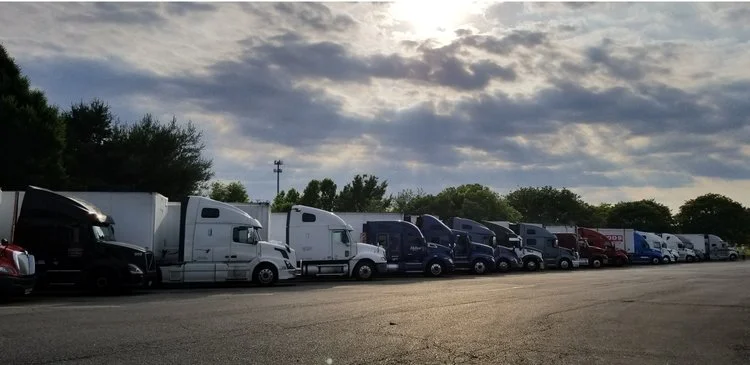
View of the truck parking area at Petro Truck Stop in Bordentown, New Jersey.
Trucking was brought up lightly in conversation some time before, and at that point, it came up again. Except this time we were genuinely ready to take the dive. Unfortunately for us, the internet held little to no information, only company review sites filled with complaints. We had no one in the industry to turn to, no family or friends that were in trucking. So then we thought, “What better way to find some real information than from the drivers themselves?” At that point in time, we had a close family member that happened to be working at a local truck stop and she was able to confirm hearing the same complaints on a daily basis. That intrigued us to drive over to the truck stop and question as many drivers as we could. We walked all over the truck stop, watching what the drivers would do, stopping people of different breeds, and asking them general advice and tips to getting started. I sought advice from a personal level, “What would you tell me if I was your daughter?” to try and get the most genuine answers possible from the drivers we came across. We got advice on both ends of the spectrum, “Stay away.” and “Do something else.” to “I wish I came out here sooner.” and “I got a PhD in Law but trucking turned out to be my passion.” When asked about income averages, drivers didn’t shy away to show us their paychecks and talk about their worst lows and highest highs. After taking all of it in, we started to look into trucking companies and training options. When we found that we could train together over the road, we were pretty much sold. We immediately saw the potential benefits of the industry. So our little trip to the truck stop worked quite well, and the information we obtained convinced us that we shouldn’t waste anymore time.